Notes From "How to Speak"
These are the notes I took while watching How to Speak, which was MIT professor Patrick Henry Winston’s yearly lecture on how to give talks.1 (It’s an iconic lecture, and you should definitely watch it). These notes are the key points, and I did the writeup mainly for myself, but I thought I’d share them here in case someone else might benefit.
Preamble
- Your success in life is largely determined by your ability to speak, write, and the quality of your ideas (in that order)
- How to improve: knowledge » practice » talent.
- The right amount of knowledge combined with practice can make you better than someone who only has talent
- Many heuristics will be presented, at the promise is that at least one of them will be useful for getting a job someday
How to Start
- Don’t start with a joke - usually will fall flat2
- Start with an empowerment promise: something the audience will take away from your talk that they didn’t know before
Heuristics
- cycling around the subject: you need to repeat things 3 times if you want everyone to remember them
- This is because at any given moment, it is likely that about 20% of the audience isn’t paying attention (for whatever reason). So you need to repeat yourself to improve the chances that everyone will get it
- fence around your idea: describe what your idea is, then what it isn’t, what it’s similar to, and what it might be confused with
- Getting everyone on the same page about what it actually is that was talked about
- verbal punctuation: giving signposts about the organization of the talk and where you are in it so that people who are lost have the opportunity to get themselves unlost
- ask a question to the audience: will help audience engagement. Choose carefully – wait max 7 seconds before giving an answer
Time and Place
- 11 am is the best time to give a lecture
- Most people are awake by them and very few people have gone back to sleep
- Lectures should happen in well-lit rooms so that people don’t fall asleep
- Case the place before you speak there
- you want to know what the place is like before you speak there so that you can deal with any challenges
- Get a room small enough that it will be at least half-full (it should be reasonably populated)
Tools
- Blackboard/whiteboard: good for informing (teaching)
- Graphic quality
- Speed: can write at about the speed of people being able to absorb ideas
- Gives you something to point at with your hands
- Slides: good for exposing ideas
- Props: good for illustrative purposes and live examples
- study playwrights! They really understand props
- Props or blackboard use encourage empathetic mirroring – audience puts itself in the shoes of the speaker performing the action, which makes it effective
Job Talks and Conference Talks
- These are about exposing ideas, not teaching them
- Most slides have too many words
- Most talks have too many slides
- Do not read your slides
- Keep clutter out of slides (no logos)
- Remove most words on slides
- Use simple images
- Do not need slide titles
- Use big font
- Laser pointers are bad because they make you turn your back to the audience
- If you want to highlight something on the slide, do it with graphics you add to the slide (such as arrows)
- Talks should not be “too heavy”
- Print all of your slides and put them next to each other to get a sense of what your talk looks like as a whole: it should have images and white space (“air”) in it
- “An hapax legomenon”
- This is a term for a massive insane slide (or diagram) that is complex
- You can get away with using one of these only once per talk (or paper, or book, or work)
Special Cases
Informing
- You need to promise something to your audience - a key takeaway that they will be able to leave with
- How do you inspire people?
- Exhibit passion about what you’re doing
- Show problems in some sort of new way
- Give people confidence that they can do the thing
- How do you teach people how to think?
- Storytelling: tell the right story
- Questions to ask about the stories
- Tools to evaluate and analyze the stories
Persuading
Oral exams (doctoral comprehensives)
- The most usual reason for a person to fail an oral exam is a failure to situate and a failure to practice
- Situating: talk about your research in context (why is this important? What is new? How long has this been a problem? etc.)
- Practice with people you don’t work with who have no idea about your field
- People you work with will hallucinate the things that are missing from your talk
- Your faculty supervisor is possibly the worst person to help you debug your talk
- Get your friends to make you cry lol
- The amount of flack you will get from somebody is proportional to age
- Young people are often trying to show the older people how smart they are
- Older faculty are much less harsh on students (you want them on your examining committee)
Job talks (for faculty candidates)
- You have 5 minutes to show that
- You have a vision (some new approach to solve a big problem)
- You have done something (list the steps to do to solve the problem)
- Conclude the talk by enumerating your contributions
Getting famous
- You can get used to being famous, but not to being ignored
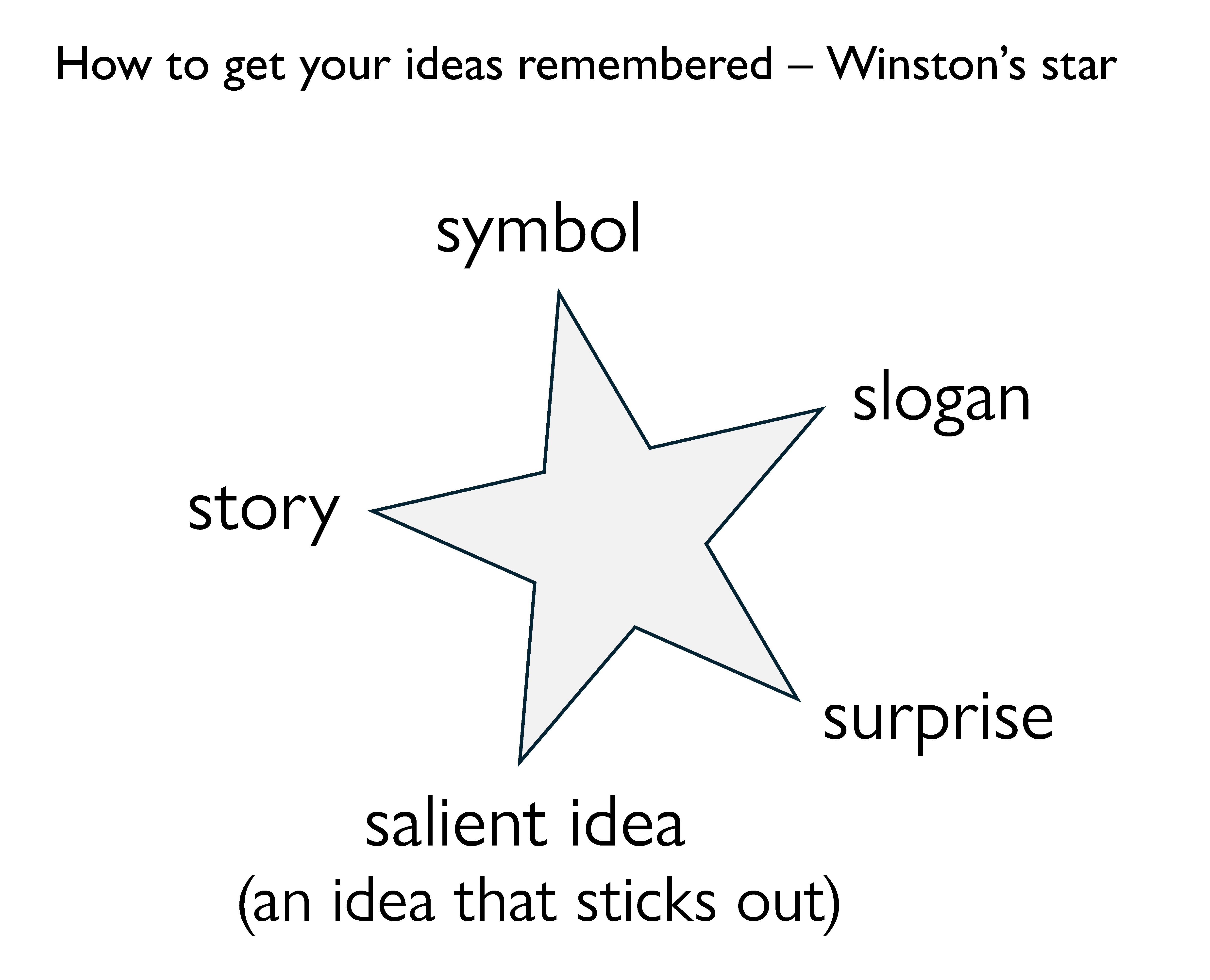
- How to get your ideas remembered – “Winston’s star”:
- Some kind of symbol that represents the idea
- A slogan that encapsulates the idea. Example: “one-shot learning”
- A surprise: something enlightening about the idea
- A salient idea - an idea that sticks out (kind of goes with the surprise idea)
- A story to go with the idea
How to Stop
- Recognize the collaborators at the beginning (not at the end)
- DO NOT end with a questions slide, or thank you, or “the end”
- Questions slide is the worst possible way to end a talk, because it could be up there for 20 minutes and squanders real estate
- These waste an opportunity to tell people who you are
- Final slide should be contributions
- Do not end with “thank you for listening” – it’s a “weak move”
- Personally I don’t know if I actually agree with this, but he did illustrate with clips of political speeches, and they do not end with “thank you”.
- Can totally end with a joke
- End by “saluting the audience”
- Say something about how much you value your time at a place.